If you are evaluating SaaS management platforms, Torii is probably on your list. They've built a solid reputation for SaaS discovery, spend optimization, and workflow automation.
But here's the thing: Torii was built for IT operations. License management. Contract renewals. Spend tracking.
What about security?
In 2026, SaaS security isn't a nice-to-have. It's the reason your CISO is breathing down IT's neck. It's what auditors ask about first. It's what keeps you up at night after reading about the latest breach.
This guide breaks down exactly how Perimeters compares to Torii, why it's a better choice for organizations that need both SaaS management and security, and how you can consolidate two tools into one while saving money.

Despite its strengths, Torii has significant limitations that become apparent when you need more than basic SaaS management:
This is the fundamental issue. Torii was built for IT operations, not security.
According to independent reviews, Torii does not have a dedicated SaaS security module to monitor and prevent app breaches. You can't evaluate risk scores for applications. You can't assess threat levels. You can't monitor for security misconfigurations across your SaaS stack.
Torii recently added "Identity Security Posture Management" to their feature list, but it's a bolt-on to an IT operations platform, not a security-first architecture.
When the Snowflake breach exposed 500+ million records because of missing MFA and stolen credentials, organizations needed security tools that could have detected those gaps. Torii's focus on license tracking wouldn't have helped.
Torii doesn't publish transparent pricing. You have to contact sales and go through a lengthy evaluation process just to get a quote.
What we know:
This pricing opacity is a red flag for budget-conscious organizations. As one analysis put it: "The mystery begins here, as Torii doesn't disclose its pricing completely... this process can be a stretch and a major red flag for SaaS buyers."
Torii's effectiveness depends on direct integrations with your SaaS applications. But they have a limited number of deep integrations, which means you may not get detailed insights into all applications in your SaaS stack.
Without direct integration, Torii can only provide surface-level information. You won't get granular usage data, security configurations, or permission details for applications outside their integration library.
Multiple user reviews highlight concerns about Torii's reporting:
For security teams that need reliable data to make risk decisions, these accuracy issues are problematic.
Despite marketing claims of easy deployment, users report:
One of Torii's key value propositions is automated offboarding. But users report mixed results:
For security teams, incomplete offboarding means orphaned accounts and lingering access, exactly the vulnerabilities that attackers exploit.
Perimeters takes a fundamentally different approach.
Instead of bolting security onto an IT operations platform, Perimeters built a security-first platform that also delivers the SaaS management capabilities you need.
The result: one platform that replaces two tools, with better security and lower cost.
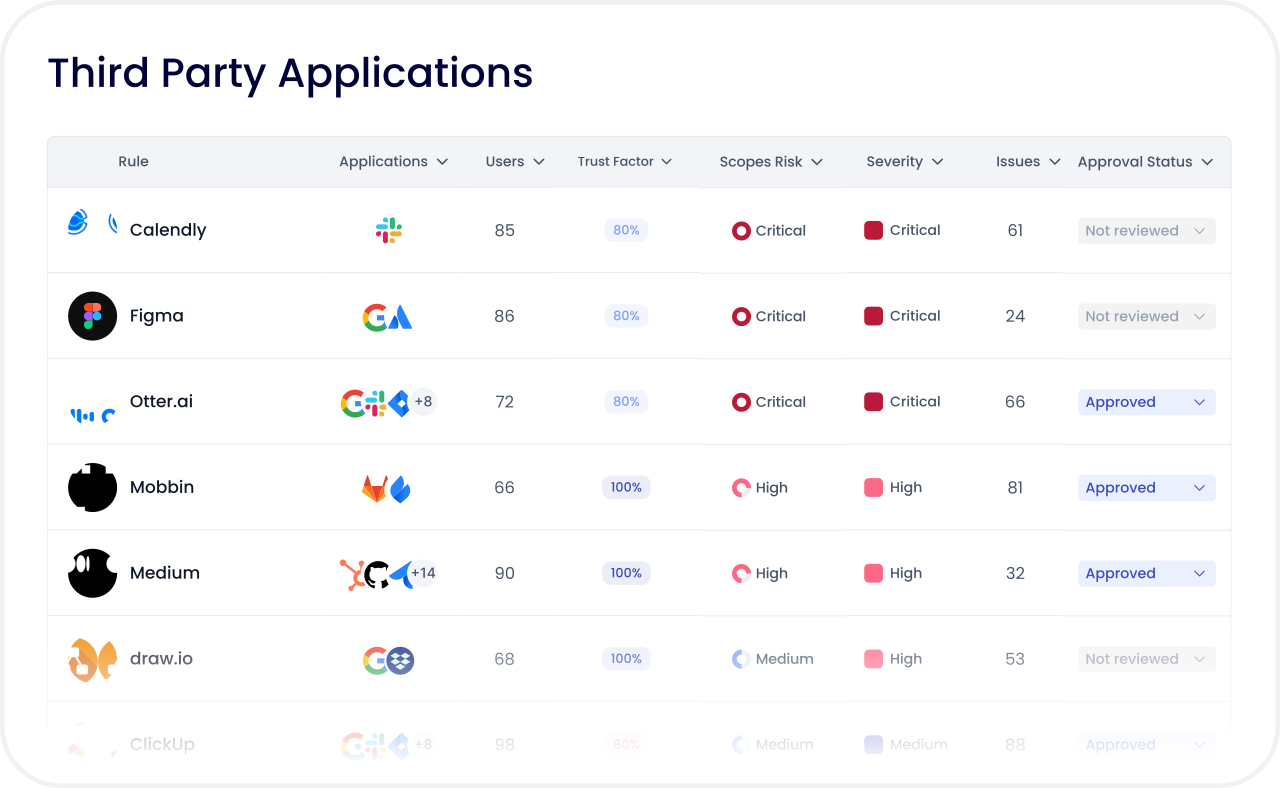
Perimeters.io was built from the ground up to secure SaaS environments. Security isn't a feature we added later; it's the foundation of everything we do.
What this means for you:
Torii's recent "Identity Security Posture Management" addition is a step in the right direction, but it can't match the depth of a platform built security-first.
Most organizations evaluating Torii are also looking at (or already running) a separate SaaS Security Posture Management (SSPM) tool. That means:
Perimeters.io eliminates this complexity. You get comprehensive SaaS discovery, spend optimization, identity governance, AND security posture management in a single platform.
We believe you shouldn't need a sales call to know what a product costs.
Perimeters.io pricing: $3 per active user per month.
That's it. No minimum commitments. No hidden costs. No enterprise-tier features held hostage behind expensive upgrades.
For a 200-person organization:
But here's the real math: Perimeters.io replaces both your SaaS management tool AND your SaaS security tool. If you're currently running Torii plus an SSPM solution (or considering adding one), Perimeters.io consolidates both at a fraction of the combined cost.
Torii users report implementation taking "days to weeks" with "pretty manual" setup requiring "a lot of time and data input."
Perimeters.io deploys in minutes.
How it works:
No browser extensions required. No financial system integrations needed for basic functionality. No weeks of configuration.
Within hours, you'll have:
Both platforms offer automation, but the approach differs significantly.
Torii's approach: Build workflows using their no-code builder. When triggers fire, workflows execute. Useful for IT operations tasks like onboarding and offboarding.
Perimeters.io approach: One-click remediation for security issues, plus automated workflows for recurring problems.
When Perimeters.io detects a risky OAuth application, you can revoke its access with a single click. When we find a misconfiguration, we show you exactly how to fix it and often can fix it automatically. When we identify a user without MFA, you can enforce enrollment immediately.
This isn't just automation for automation's sake. It's automation designed to reduce your attack surface as quickly as possible.
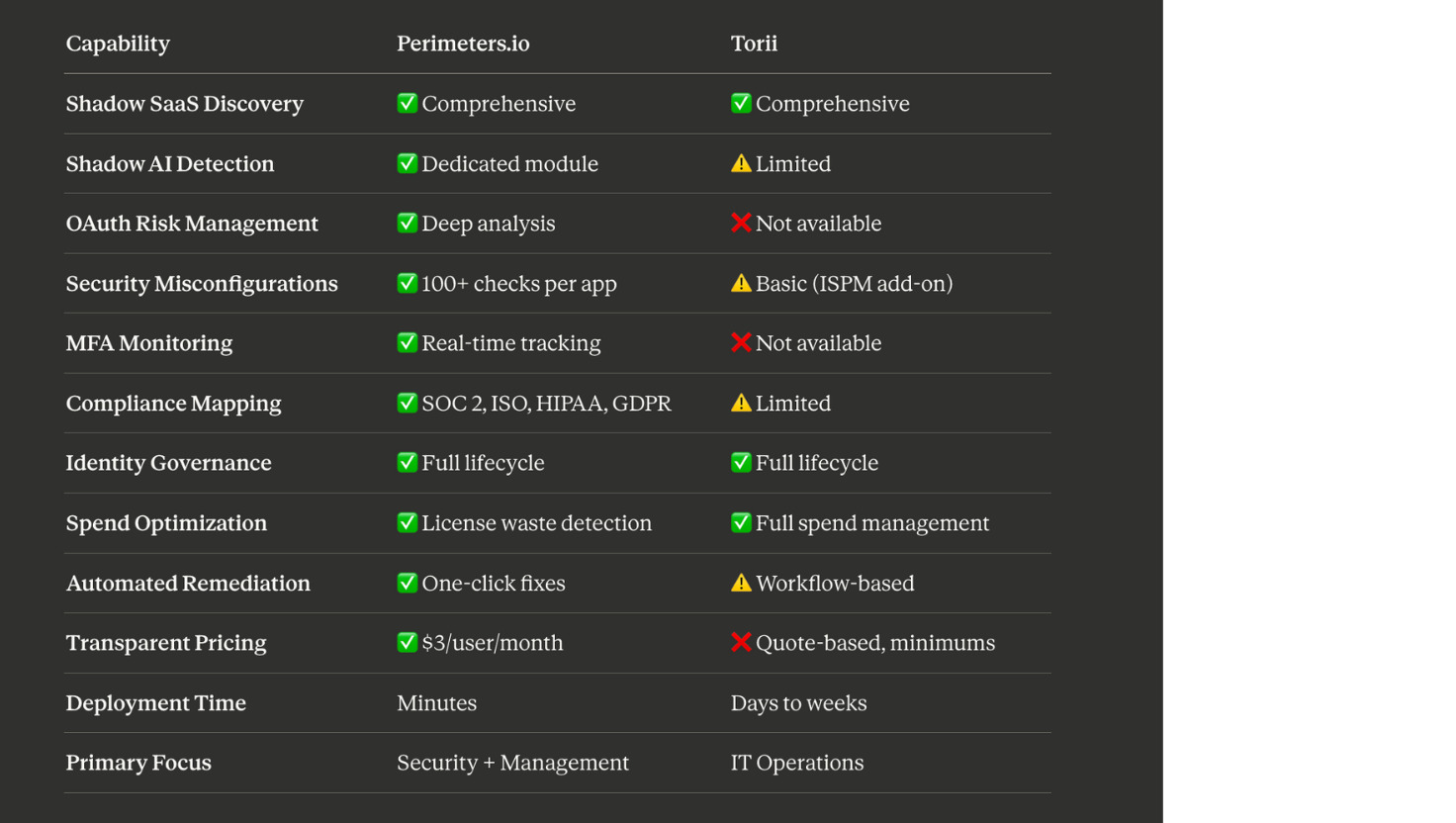
Let's walk through a scenario that illustrates the difference between Torii's IT operations approach and Perimeters.io's security-first approach.
The situation: An employee in marketing connects a new AI writing tool to Google Workspace. They grant it access to read their emails and edit their documents.
What Torii sees:
What Torii misses:
What Perimeters sees:
The outcome:
With Torii, the risky application continues operating until someone manually investigates (if ever).
With Perimeters.io, the security team is alerted immediately, can revoke access with one click, and can implement policies to prevent similar issues.
This is the difference between IT operations and security.
If you're currently using Torii and want to switch to Perimeters.io, the migration is straightforward:
Week 1: Parallel Deployment
Week 2: Validation
Week 3: Transition
Week 4: Decommission
Most organizations complete the migration in 2-4 weeks with minimal disruption.
The choice between Torii and Perimeters.io comes down to what you need:
Choose Torii if:
Choose Perimeters if:
For most organizations in 2026, SaaS security isn't optional. Breaches like Snowflake, Salesloft Drift, and countless others have proven that SaaS environments are prime targets.
Perimeters.io gives you comprehensive security AND the SaaS management capabilities you need, at a price that makes sense, in a platform that deploys in minutes.
That's why we're the ultimate Torii alternative.
Ready to see the difference?
Book a demo to see what the Perimeters hype is about.
Torii is a SaaS Management Platform (SMP) that helps organizations discover Shadow IT, optimize SaaS spending, automate IT workflows, and manage the SaaS application lifecycle. It's primarily focused on IT operations use cases like license management, contract renewals, and user onboarding/offboarding.
Torii doesn't publish transparent pricing. Based on available information, pricing starts around $2.50/employee/month for basic tiers, with a minimum commitment of $250/month. Enterprise pricing requires contacting sales. Multiple sources describe Torii as expensive, especially for smaller organizations.
Torii is primarily an IT operations tool, not a security tool. They recently added "Identity Security Posture Management" capabilities, but Torii lacks dedicated security features like OAuth risk management, misconfiguration detection, and compliance mapping that purpose-built SSPM platforms provide.
Yes. Perimeters.io provides SaaS discovery, identity governance, and spend optimization capabilities similar to Torii, plus comprehensive SaaS security features. Most organizations can consolidate both their SaaS management and SSPM tools into Perimeters.io.
Perimeters.io costs $3 per active user per month with transparent, published pricing. There are no minimum commitments or hidden costs. For most organizations, this is significantly more affordable than Torii, especially when you factor in the ability to eliminate a separate SSPM tool.
Perimeters.io deploys in minutes through API connections to your SaaS applications. Users report Torii implementation taking "days to weeks" with significant manual setup required.